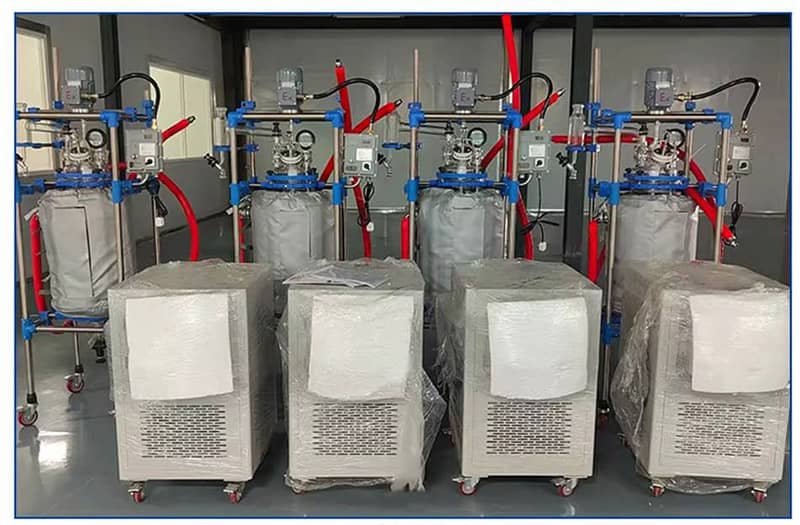
In laboratory pilot tests and fine chemical production, the rationality of the matching of double-glazed reactors and high and low temperature all-in-one machines directly determines the temperature control accuracy, reaction efficiency and equipment life. Mismatched configurations can lead to slow temperature ramp-up, large temperature control fluctuations, and even equipment damage. This paper analyzes the key points of matching between the two from five dimensions: volume matching, power matching, temperature control accuracy, circulation system, and safety compatibility.
The volume of the double-glazed reactor is the primary basis for selecting a high and low temperature integrated machine. The flow requirements and heat load bearing capacity of the circulating medium of reactors of different volumes were significantly different.
| reactor volume | The high and low temperature all-in-one model is recommended | Circulation pump flow requirements | Typical application scenarios |
|---|---|---|---|
| 10L~20L | 2.5kW | ≥20L/min | Laboratory research and development, small tests |
| 50L | 5.5kW | ≥35L/min | Small batch production, process optimization |
| 100L | 7.5kW | ≥50L/min | Pilot scale-up and mass production |
| 200L | 15kW | ≥75L/min | Pilot production and industrialization transition |
Matching principles:
Flow Matching: The flow rate of the circulating pump of the high and low temperature all-in-one machine should be greater than the flow required by the reactor jacket to ensure that the thermal conductive medium forms a forced circulation in the jacket to avoid local overheating or overcooling.
Head matching: The head of the circulation pump needs to overcome the pipeline resistance and reactor height difference, usually requiring a head ≥ 20m (100L kettle).
The choice of heating power depends on:
Specific heat capacity of materials: water materials have a high specific heat capacity and require more power; Organic solvents have a low specific heat capacity and require relatively little power.
Heating rate requirements: If the process requires rapid heating (e.g., from room temperature to 150°C within 30 minutes), higher power equipment should be selected.
Ambient heat dissipation loss: When the 100L reactor is running at high temperature (>150°C), the heat dissipation loss can reach 1kW~2kW, and the margin needs to be reserved.
Experience Formula:
Required heating power (kW) = [material weight (kg)× specific heat capacity (kJ/kg·°C)× heating rate (°C/s)] + heat dissipation loss
For a 100L reactor (about 80L~100L of liquid when fully filled), the recommended heating power is 6kW~10kW.
The cooling power needs to meet:
Reaction heat: The heat generated during the exothermic reaction needs to be removed in time
Cooling rate requirements: If the crystallization process needs to be quickly cooled down to below 0°C
Final temperature: The lower the temperature, the more obvious the decay of refrigeration efficiency
Matching suggestions:
100L reactor conventional exothermic reaction: refrigeration power 3kW~5kW (-20°C working condition)
Strong exothermic reaction or rapid cooling requirements: cooling power 6kW~8kW (-40°C working condition)
The requirements for temperature range vary greatly from process to process:
| Process type: | Typical temperature range | The high and low temperature integrated model is recommended |
|---|---|---|
| Conventional synthesis | -20℃~150℃ | Standard type (-20°C~200°C) |
| Cryogenic reaction | -40℃~100℃ | Low temperature type (-40°C~200°C) |
| High temperature distillation | Room temperature ~200°C | High temperature type (normal temperature ~250°C) |
| Wide temperature range process | -40℃~200℃ | Full temperature type (-40°C~200°C) |
Matching suggestion: Choose equipment with a slightly wider temperature control range than the process requirements, and leave a margin of 20°C~30°C to cope with process fluctuations.
The temperature control accuracy depends on the control algorithm and sensor configuration of the high and low temperature all-in-one machine:
| Accuracy level | Temperature fluctuations | Applicable scenarios | Recommended configuration |
|---|---|---|---|
| Normal temperature control | ±1℃~±2℃ | Conventional synthesis, distillation | PID control |
| Precise temperature control | ±0.5℃ | Crystallization and polymerization reactions | PID+ adaptive algorithm |
| High precision temperature control | ±0.1℃ | Pharmaceutical research and development, fine synthesis | Serial PID + high-precision sensor |
For the pilot process of 100L reactor, the recommended temperature control accuracy ±0.5°C.
1. Pipeline connection
Interface specifications: The interface of the inlet and outlet of the high and low temperature all-in-one machine and the reactor jacket needs to be matched, and the common specifications are DN15, DN20, DN25. It is recommended to use DN20 or DN25 interface for a 100L reactor to reduce pipeline resistance.
Pipeline material: It is recommended to use stainless steel bellows or high-temperature silicone pipes, the former has good pressure and temperature resistance, and the latter has good flexibility and is easy to connect.
Thermal insulation treatment: When running at high temperatures, the pipeline should be wrapped in insulation cotton to reduce heat loss; When operating at low temperatures, the pipeline needs to be treated with anti-condensation.
2. Thermal conductivity medium selection
The thermal conductive medium is the carrier of heat, and choosing the wrong medium may cause damage to the equipment or the failure of temperature control.
| Temperature range | Recommended medium | Notes: |
|---|---|---|
| -40°C~room temperature | Silicone oil (low-temperature type), ethylene glycol aqueous solution | Aqueous ethylene glycol solution is easy to deteriorate at high temperatures for a long time |
| Normal temperature ~150°C | water, thermal oil | Water is easy to scale and needs to be changed regularly |
| 150℃~200℃ | High-temperature thermal oils (e.g., synthetic oils) | Choose a high flash point medium to ensure safety |
| -40℃~200℃ | Fully synthetic thermally conductive silicone oil | The price is higher, but the performance is stable and the service life is long |
Matching Recommendation: For applications with a wide temperature range of -40°C~200°C, it is recommended to use fully synthetic thermally conductive silicone oil to avoid frequent media changes.
1. Explosion-proof requirements
If the reactor is used for organic solvents, flammable and explosive materials, it is necessary to match the explosion-proof configuration:
| Equipment | Explosion-proof requirements | Explosion-proof level reference |
|---|---|---|
| Reactor | Explosion-proof motor, explosion-proof control box | Ex d IIB T4 |
| High and low temperature all-in-one machine | The whole machine is explosion-proof or explosion-proof electronic control | Ex d IIB T4 / Ex e IIB T4 |
Matching suggestion: The explosion-proof high and low temperature all-in-one machine must be selected for the explosion-proof environment, and only the reactor is explosion-proof and the temperature control equipment is not explosion-proof, which has potential safety hazards.
2. Communication integration
If you need to connect to DCS, PLC or achieve remote monitoring, you need to confirm:
Whether the high and low temperature all-in-one machine supports RS485/Modbus, Ethernet and other communication protocols
Whether the reactor temperature sensor is compatible with the signal of the temperature control equipment (Pt100, thermocouple, etc.)
| Problem phenomenon | Possible causes | Solution |
|---|---|---|
| Slow warming | Insufficient heating power, long pipeline and large heat dissipation | Upgrade higher power equipment, shorten piping and keep warm |
| Slow cooling | Insufficient cooling power and high medium viscosity | Increase the refrigeration power and replace the low-viscosity thermal oil |
| Large temperature fluctuations | The control algorithm does not match and the sensor response is slow | Choose PID adaptive equipment and replace high-precision sensors |
| The circulation pump is overloaded | The pipeline resistance is large and the medium viscosity is too high | Increase the pipe diameter and replace the low-viscosity medium |
| High temperature smoke | The flash point of the thermal conductive medium is too low | Replace the high flash point thermal oil |
| project | Recommended configuration |
|---|---|
| Reactor | 100L double glass reactor, high borosilicate glass, explosion-proof motor, DN25 jacketed interface |
| High and low temperature all-in-one machine | The temperature control range is -40°C~200°C, the heating power is 7.5kW, the cooling power is 5kW (-20°C), the circulation pump flow rate is 50L/min, and the head is 25m |
| Thermal conductive medium | Fully synthetic thermally conductive silicone oil, working temperature -50°C~220°C |
| pipeline | Stainless steel bellows, DN25 interface, outer insulation cotton |
| Control system | RS485 communication interface, supports Modbus protocol, can be connected to DCS |
When selecting the model, it is recommended to match the five dimensions of volume→ power→ temperature control accuracy→ and safety compatibility of the circulation →system layer by layer, and consult professional engineers for heat load accounting when necessary to ensure the best performance of the whole system.
Contact: Neil
Phone: +86-18205509969
E-mail: sales@zooany.com
Add: 118, Building 3, Tianrun City Phase II, Tianchang City, Anhui Province. China