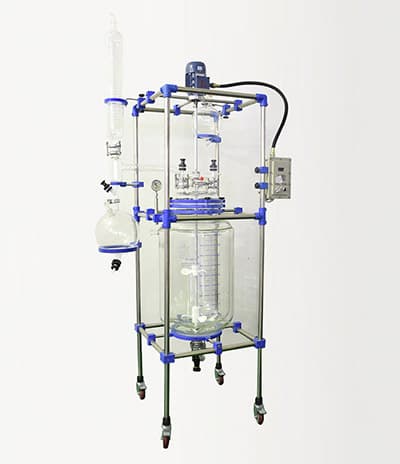
Q1: What is the basic process of operating a glass reactor?
The basic process can be divided into three steps: check, run, and end.
1. Preparation before operation: Carefully inspect the kettle body and glass components for cracks or scratches, and confirm that the metal frame is stable. After each glass interface is matched, wipe it with a soft cloth and apply vacuum grease to ensure sealing. Wear protective gloves and goggles during operation.
2. During operation monitoring: The material filling amount should not exceed 2/3 of the kettle volume. Mixing should be gradually adjusted from low speed to the desired speed, and attention should be paid to observing for any abnormal vibration or noise during operation.
3. Shutdown operation: After completion, first turn off the mixing motor and wait for it to come to a stop before turning off the temperature control device. After the kettle body has cooled to room temperature, the material is discharged through the bottom discharge valve. It is strictly prohibited to disassemble the equipment when it is under pressure.
Q2: How to properly clean and maintain a glass reactor?
Clean it promptly after each use to prevent residue accumulation.
Daily cleaning: Use neutral detergent and soft cloth to clean the kettle body. For stubborn stains, they can be soaked in solvents such as acetone while hot, or soaked in a 10% nitric acid solution for 30 minutes before rinsing. It is strictly prohibited to use hard brushes or sandpaper to prevent scratching the glass.
Component maintenance: Regularly remove and clean the sealing ring on the mixing shaft, apply vacuum grease before reinstalling, and maintain lubrication.
Long term storage: The equipment should be disassembled and stored in a dry and ventilated place. Glass components should be wrapped separately with soft cloth, and metal components can be coated with a thin layer of anti rust oil.
Q3: What are the common vacuum degree problems? How to solve it?
Vacuum failure is a common problem, which can be solved by following the steps below:
Phenomenon: There is a vacuum but it cannot be pulled up, there is air leakage, or the pressure is not maintained.
Troubleshooting and resolution:
1. Check the sealing ring: This is the most common reason. The sealing ring may be aged or worn and needs to be replaced; If there is a lack of oil at the sealing point, vacuum grease can be applied.
2. Check interfaces: Ensure that all glass interfaces and flange connections are tightened and well sealed.
3. Check the pipeline: The vacuum connection hose may be aged or damaged, causing air leakage, and needs to be replaced in a timely manner.
4. Check the vacuum pump: Confirm that the vacuum pump itself is working properly, and there are no faults with the oil level, impeller, etc.
5. Check glass components: Carefully inspect the glass components such as the kettle body and condenser for any inconspicuous cracks, and replace them immediately if found.
Q4: What should I do if the mixing system malfunctions?
The common faults and their solutions are as follows:
Phenomenon 1: The power indicator light is on, but the agitator does not rotate.
Reason: The shaft may rust and get stuck, or the motor/electrical box may malfunction.
Solution: Shutdown inspection. If it is rusting, contact the supplier for handling; If it is an electrical fault, check if the seven pin plug is connected or ask a professional to repair it.
Phenomenon 2: There is abnormal noise or severe vibration during mixing.
Reason: The stirring blade may be loose or collide with the bottom of the kettle; The motor bearings may be worn.
Solution: Immediately stop the machine, check and tighten the mixing blade; Check the motor and bearings, and replace them if necessary.
Q5: What should I do if the temperature control of the reactor fails or if there is abnormal heating/cooling?
Reason: Malfunction of temperature control device, damage or poor contact of temperature sensor, malfunction of heating/cooling system (such as heating tube, circulation pump).
Solution: First, check if the temperature sensor probe is correctly placed and in good contact. Then calibrate the temperature control instrument. If the problem persists, it is necessary to check whether the heating tube is damaged or the cooling pipeline is blocked, and contact professional personnel for repair or replacement.
Q6: What is the main reason for the damage of the glass kettle body?
The rupture of the glass kettle body is mainly caused by the following reasons, which need to be prevented with emphasis:
Mechanical impact: collision with hard objects (such as tools, watches, rings, etc.) during installation, cleaning, or operation. Be sure to remove hard objects during operation.
Thermal stress shock: Rapid temperature rise and fall or sudden cooling and heating can cause glass to break due to excessive temperature difference between the inside and outside. The heating and cooling rate should be strictly controlled, usually not exceeding 5 ℃/min.
Pressure exceeding limit: Glass reaction vessels usually have good resistance to negative pressure (vacuum), but their ability to withstand positive pressure is limited (generally<0.1 MPa), and overpressure operation may cause explosions.
Contact: Neil
Phone: +86-18205509969
E-mail: sales@zooany.com
Add: 118, Building 3, Tianrun City Phase II, Tianchang City, Anhui Province. China