The material determines durability and suitability. This is the primary selection criterion.
| Material | Chemical Resistance | Heat Resistance | Recommended Scenario |
|---|---|---|---|
| PP (Polypropylene) | Excellent | Moderate (~80°C) | General first choice. Suitable for most chemistry labs (acids, alkalis, organic solvents). |
| Aluminum alloy | Poor | Excellent (~200°C) | High-temperature use. For applications above heat sources, but vulnerable to corrosive chemicals. |
| Stainless steel | Good | Excellent | High strength, demanding conditions. For atomic absorption instruments or environments requiring mechanical robustness. |
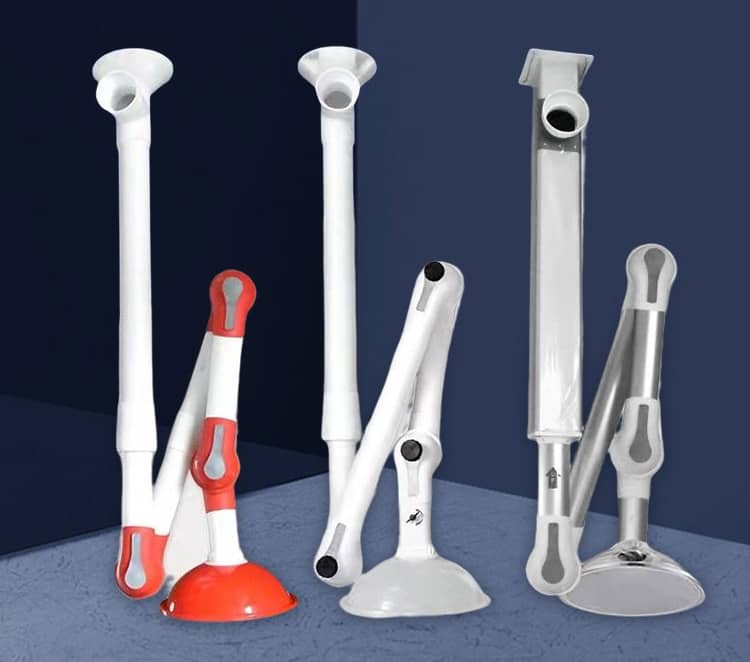
After choosing the material, check these mandatory parameters:
Face velocity (capture velocity) : ≥ 0.35 m/s (at the hood opening). This is the most critical indicator. Below this, harmful substances cannot be effectively removed.
System airflow rate : Typical design range per unit: 150–350 m³/h; commonly 200–300 m³/h. For duct design, maintain main duct velocity at 6–8 m/s.
Duct diameter : Common sizes: 75 mm and 110 mm – must match the system.
Reach radius : Choose based on workstation layout; common reach around 1.6 metres.
Most exhaust arms have a manual adjustment valve at the hood opening. By rotating or sliding it, you directly open/close the baffle to quickly change airflow.
If the arm is connected to a central system and one valve controls multiple units, or if total airflow is too high/low, a trained technician should adjust the main or branch duct dampers to balance the system.
For safety, airflow must be validated. Use a hot-wire anemometer (never a vane anemometer). With the hood fully open, measure the air velocity at the centre of the hood opening. It must be ≥ 0.35 m/s.
Positioning : Place the hood as close to the contaminant source as possible – recommended distance 15–30 cm (for welding applications, ≤25 cm). The vertical distance from mounting point to ceiling is typically between 1710 mm and 2440 mm.
Basic procedure : Secure the bracket with expansion bolts → connect ducting and lock joints → adjust joints and hood position, tighten knobs → test airflow. Ceiling and wall mounting have slight differences – follow the product manual.
Good practices : Turn on the fan before starting experiments, delay shutdown after finishing; after repositioning the arm, tighten the knobs; avoid forceful pulling.
Regular maintenance : Check joints for looseness monthly; clean inside and outside every six months (avoid damaging parts); replace filters (e.g., activated carbon) as specified by the manufacturer.
Safety warnings : NEVER use the exhaust arm for high-concentration, flammable/explosive, or highly toxic gases. Regularly check activated carbon or other filters – replace immediately when spent.
Contact: Neil
Phone: +86-18205509969
E-mail: sales@zooany.com
Add: 118, Building 3, Tianrun City Phase II, Tianchang City, Anhui Province. China