The ZALFGR series stands out due to several engineering upgrades:
Lifting & Rotation: Manual lifting for easy feeding and crystal removal; the kettle body rotates 0~120° for thorough cleaning.
Advanced Sealing: Uses a flange connection sealing method (no vacuum grease required), providing superior sealing, higher vacuum levels, and eliminating the common issue of "stuck" joints.
Bottom-Feeding Design: A blind-spot-free bottom-feeding design ensures complete mixing and reaction, simplifies cleaning, and prevents cross-contamination.
Structural Stability: A parallel steel base and full-flange connectors enhance operational stability and can withstand positive pressure up to 0.03Mpa.
The full system typically includes:
| Unit | Components |
|---|---|
| Reactor Body | Jacketed GG17 glass vessel, working volume 10L, split-type lower discharge valve. |
| Stirring Unit | Overhead stirring system with double-seal bearings; stirring paddle (PTFE double-layer). |
| Vacuum Unit | Options: diaphragm pump, rotary vane oil-sealed pump, or circulating water pump. |
| Temperature Control | Variable frequency constant-speed stirring system; optional ZN intelligent controller. |
| Feeding/Dropping | Liquid feeding and dropping unit. |
| Lifting/Rotary Unit | Manual lifting mechanism + 0~120° rotation. |
| Custom Units | Special customized add-ons available per request. |
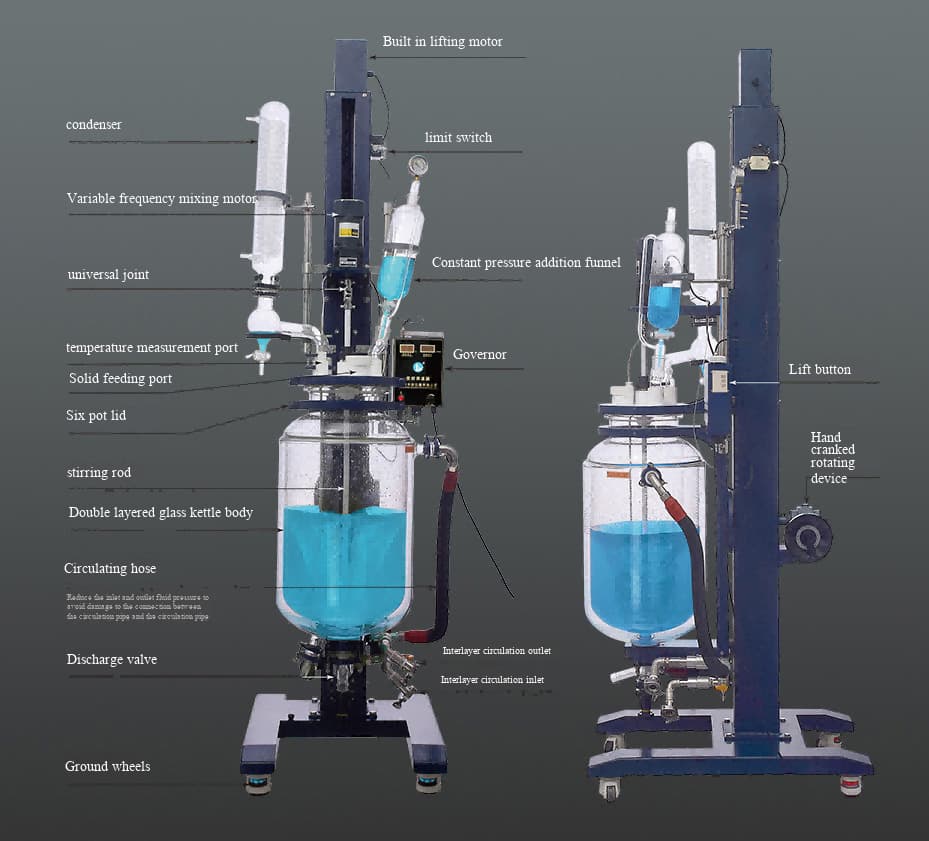
Material: High borosilicate glass (GG17) with excellent chemical corrosion resistance.
Design: 10L jacketed reactor with a 6-open kettle cover (ports for stirrer, constant pressure dropping funnel, reflux condenser, temperature sensor, solid/liquid feeding).
Sealing: Kettle lid and body are sealed via handwheel lifting and squeezing (flange type, grease-free).
Base & Mobility: Parallel steel base for stability, equipped with casters for easy movement; the entire system can move as one unit, allowing flexible spatial placement.
Sealing: Double-seal stirring bearing ensures high system airtightness.
Material Options: Glass, stainless steel, or PTFE-coated fluorine materials available.
Stirring Paddle: Standard PTFE double-layer mixing paddle; other types of impellers can be easily swapped based on experimental needs.
Offers multiple pump options:
Diaphragm vacuum pump
Rotary vane-type oil-sealed vacuum pump
Circulating water-type multi-purpose vacuum pump
Standard: Digital display of stirring speed with variable frequency control for smooth, constant-speed operation.
Optional Upgrade (ZN Intelligent System): Real-time display of temperature, acidity, viscosity (torque), and stirring speed; supports stage programming control, feeding pump speed/time control, and PC connectivity for remote data collection, recording, and curve plotting.
| Aspect | ZALFGR Series Advantage |
|---|---|
| Sealing Integrity | Grease-free flange seals deliver higher vacuum levels and no joint-sticking. |
| Operational Flexibility | 0~120° rotation + manual lift makes cleaning and crystal removal effortless. |
| Reaction Efficiency | Blind-spot-free bottom feeding ensures complete mixing and prevents cross-contamination. |
| Smart Control | Optional ZN system enables real-time monitoring, programming, and remote PC control. |
| Corrosion Resistance | All wetted parts are GG17 glass or PTFE, suitable for aggressive chemicals. |
| Mobility | Integrated casters allow whole-system movement with stable positioning. |
This reactor series is ideal for pilot-scale R&D in pharmaceuticals, fine chemicals, and material science, where precision, cleanliness, and process automation are critical.
Contact: Neil
Phone: +86-18205509969
E-mail: sales@zooany.com
Add: 118, Building 3, Tianrun City Phase II, Tianchang City, Anhui Province. China