Regarding the core technology, applications, and selection of Temperature Control Units (TCUs), their core value lies in serving as the "temperature control brain" of industrial production. Through precise, stable, and repeatable temperature management, they directly determine the quality of the final product, production efficiency, and safety.
Basic Principle: A TCU is a closed-loop temperature control system. It uses a circulation pump to circulate a heat transfer medium (such as water or thermal oil) between the TCU and the jacket of equipment like reactors. It employs algorithms such as PID to control heating/cooling power, dynamically adjusting the medium temperature to achieve precise temperature control.
Key Technologies: Modern TCUs commonly adopt adaptive PID control, feedforward-feedback composite control, as well as advanced fuzzy logic control and Model Predictive Control (MPC). Simulation and structural optimization through Computational Fluid Dynamics (CFD) and Finite Element Analysis (FEA) ensure the equipment's high-efficiency heat transfer and reliability.
Core Components: A TCU consists of heating/cooling elements (e.g., electric heaters, compressors), a circulation pump (e.g., magnetically driven pump), heat exchangers (e.g., high-efficiency plate heat exchangers), various sensors, and a core controller. For safety protection, multiple mechanisms such as dual over-temperature protection and medium leak monitoring are typically in place.
Performance Parameters: Key parameters include temperature range (e.g., -25°C to 200°C), temperature control accuracy (typically between ±0.1°C and ±1°C), heating/cooling capacity, pump flow rate and pressure (to meet different process requirements), and communication interfaces (supporting industrial protocols like RS485, Profinet).
Classification Overview:
| Classification Standard | Equipment Type | Characteristics and Applications |
|---|---|---|
| By Operating Environment | Standard, Explosion-Proof | Explosion-proof types use positive pressure ventilation, isolation design, etc., for chemical environments handling flammable and explosive materials. |
| By System Structure | Fully Closed, Open | Fully closed systems prevent medium oxidation, extend service life, and suit a wide temperature range; open constant temperature baths meet specific needs. |
| By Medium Type | Water TCU, Oil TCU, Combined Heating & Cooling Unit | Water TCU (≤120-180°C), Oil TCU (≤300-350°C), Combined Heating & Cooling Units integrate heating and cooling, covering the widest temperature range. |
Pharmaceutical: Precisely controls bioreactors (37±0.2°C) and lyophilization processes to ensure drug quality.
Chemical: Controls the temperature of hazardous reactions like polymerization and nitration, achieving energy savings and efficiency gains.
Semiconductor: Provides precise temperature control of ±0.3°C in processes such as thin-film deposition, a key factor in improving chip yield.
Scientific Research: Provides fundamental temperature control environments for experiments like material characterization and new battery testing.
New Energy Vehicles: Used for simulation testing and production line temperature control of battery pack thermal management systems, motors/electronic control systems, and battery material production lines.
Other Industries: Also indispensable core equipment in sectors like food processing (fermentation), and plastics & rubber (injection molding, extrusion).
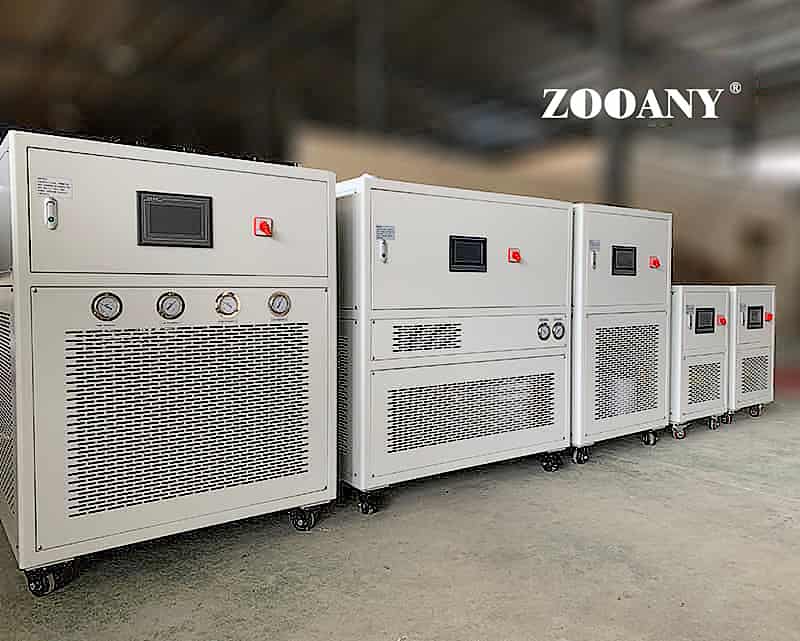
Selection: The key lies in accurately calculating the heat load, clarifying the temperature range, accuracy, and medium type, confirming the installation environment (e.g., explosion-proof area, cleanroom), and planning for system integration (e.g., communication protocols with PLC/DCS).
Maintenance: Regularly clean the condenser/evaporator, check system airtightness, manage the heat transfer medium, and periodically calibrate the temperature sensors.
Trends: The industry is moving towards greenization (using low-GWP refrigerants), integration (modular, skid-mounted solutions), intelligence (IoT-based remote operation and maintenance), and high precision and specialization (meeting the demands of emerging fields).
A TCU is a critical foundational piece of equipment spanning multiple industries. From macro-level system matching to micro-level precision control, every step is crucial. It is hoped that the above information establishes a comprehensive knowledge framework for you regarding TCU.
Contact: Neil
Phone: +86-18205509969
E-mail: sales@zooany.com
Add: 118, Building 3, Tianrun City Phase II, Tianchang City, Anhui Province. China