100L jacketed glass reactor and heating and cooling circulator: how to build an efficient and accurate temperature control reaction system?
In R&D and pilot production in the fields of fine chemicals, biopharmaceuticals, and new material synthesis, the accuracy of temperature control and the stability of the reaction directly determine the reliability of experimental results and the success rate of process scale-up. In recent years, the combination of 100L double-glazed reactor and heating and cooling circulator has become a "golden partner" in laboratories and pilot workshops with its advantages of wide temperature range control, visual operation and high safety. This article will provide an in-depth analysis of the core value of this combination from four dimensions: equipment characteristics, synergy advantages, selection points, and application scenarios.
The design essence of the double-glazed reactor lies in its double-layer jacketed construction. The inner layer provides a fully transparent reaction environment for the reaction material, and researchers can intuitively observe the stirring state, color change, crystallization process and other key information of the material. The outer jacket serves as a circulation channel for the thermally conductive medium, and realizes indirect temperature control of the reaction material by injecting high or low temperature liquid.
The 100L specification belongs to the pilot grade reactor, and its core advantages are reflected in three aspects:
Material and corrosion resistance: The kettle body is made of 3.3 high borosilicate glass, which has excellent chemical stability, strong acid, alkali and a variety of organic solvent corrosion, and has a low coefficient of thermal expansion, which can withstand the cold and hot shock of -80°C to 250°C.
Mixing system: usually equipped with explosion-proof motor and double-layer push mixing paddle, the speed is adjustable (50~600rpm) to ensure that the high-viscosity materials are mixed evenly within a volume of 100L without dead ends.
Multi-functional interfaces: The lid is equipped with multiple sets of standard interfaces, which can be connected to temperature probes, pH meters, condensers, constant pressure drip funnels, etc., supporting various process needs such as distillation, reflow, and extraction.
If the reactor is the "heart", then the heating and cooling circulator is the "temperature control center" that powers it. Unlike the unidirectional temperature control of traditional heating circulators or cryogenic coolant circulation pumps, the heating and cooling circulator integrates heating and cooling, and can achieve continuous temperature control from -80°C to 200°C or even a wider range without changing media or switching equipment.
Its core benefits include:
Dynamic constant temperature technology: Using PID or more advanced adaptive control algorithms, the response speed is fast, and the temperature fluctuation of the thermal conductive medium in the jacket can be controlled within ±0.5°C, thereby ensuring the stability of the temperature of the reactive material.
Fully enclosed circulation system: The thermal conductive medium (such as silicone oil) circulates in the fully enclosed pipeline, with no oil mist volatilization at high temperature and no moisture absorption condensation at low temperature, extending the life of the medium and ensuring the safety of the laboratory environment.
Multi-purpose machine: It can not only independently provide cold or heat source for the reactor, but also can be used with reactors, rotary evaporators, fermenters and other equipment, with high utilization.
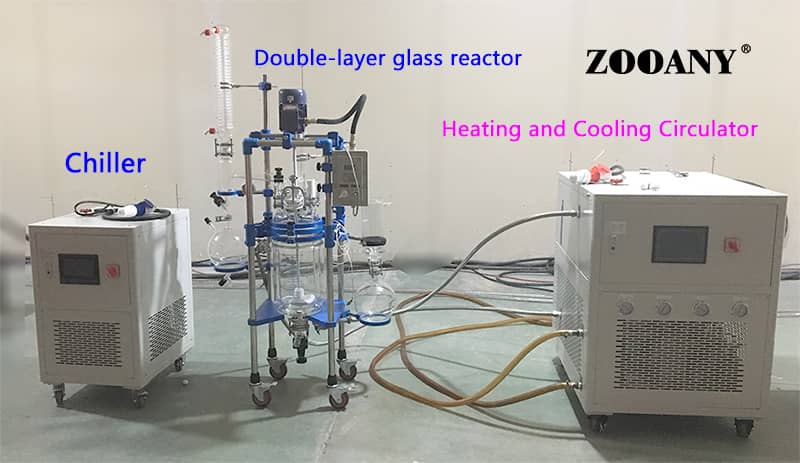
3. 1+1>2: The three core advantages of collaborative operation
The combination of the 100L jacketed glass reactor with the heating and cooling circulator is not a simple superposition of equipment, but achieves the following systematic improvements:
3.1. Wide temperature range is continuously controllable to meet complex process requirements
Many synthesis reactions need to be carried out under a complete temperature control curve of heating, constant temperature, and cooling. For example, the synthesis of a pharmaceutical intermediate needs to be heated to 150°C for esterification reaction, and then rapidly cooled to 0°C for crystallization and precipitation. The independent heating and cooling circulator can automatically execute the temperature control program throughout the process, eliminating the need to manually handle coolant or replace pipelines, greatly improving process repeatability and efficiency.
3.2. Improve both safety and reliability
The jacket design of the double-glazed reactor itself reduces the risk of direct contact with the material by the heating wire, and the multiple safety protections (such as over-temperature protection, liquid shortage alarm, and pressure protection) of the high-low temperature all-in-one machine further escort the safety of the reaction. The combination of the two is particularly suitable for dangerous reaction systems with severe heat release or sensitivity to temperature.
3.3. Energy conservation, consumption reduction and environmental protection
The fully enclosed circulation system used in the heating and cooling circulator reduces the volatilization and loss of the thermal conductive medium, and the frequency conversion technology of the compressor can adjust the power according to the actual load, which can reduce the comprehensive energy consumption by 20%~30% compared with the independent operation of the traditional heating + refrigeration equipment.
3.4. Key points of selection and configuration
In actual procurement and matching, it is recommended to focus on the following technical parameters:
100L jacketed glass reactor - kettle body material high borosilicate glass 3.3 to ensure temperature difference resistance and corrosion resistance;
Stirring motor-explosion-proof motor is preferred, suitable for organic solvent environment;
Discharge valve - Teflon discharge valve, no dead angle design, easy to clean;
Explosion-proof heating and cooling circulator - temperature control range It is recommended to choose -40°C~200°C or -80°C~200°C to cover most reaction needs;
Heating/cooling power -100L reactor is recommended to be equipped with 7.5kW~10kW heating power, and the cooling power needs to match the reaction heat load;
Circulation pump flow rate - The flow rate of the circulation pump is not less than 50L/min, and the head is enough to overcome the pipeline resistance;
Communication interface - RS485/232 or Ethernet interface for easy access to DCS or PLC control system.
3.5. Typical application scenarios
Pharmaceutical R&D and pilot testing: used for API synthesis, crystallization process optimization, low-temperature reaction, etc., to meet the requirements of visual production under GMP specifications.
New material synthesis: such as polymer polymerization, liquid crystal material preparation, and other processes that require extremely high temperature uniformity and stability.
Fine chemicals: small-batch, multi-variety production scenarios such as flavors and fragrances, electronic chemicals, etc.
New energy materials: synthesis and treatment of lithium electrolytes and solid electrolyte precursors.
The combination of 100L jacketed glass reactor and heating and cooling circulators represents the trend of modern laboratories and pilot production towards integration, precision and safety. This combination not only solves the pain points of traditional temperature control methods such as slow response, cumbersome operation, and many potential safety hazards, but also provides reliable data support for process scale-up.
For R&D personnel and production managers, it is necessary to jump out of the thinking of "single equipment procurement" when selecting the type, and match it from the perspective of the overall temperature control system to ensure that the volume and stirring characteristics of the reactor are best coordinated with the power and temperature control accuracy of the high and low temperature integrated machine. Only in this way can this "golden combination" truly exert its due value in improving efficiency, ensuring safety, and optimizing processes.
Contact: Neil
Phone: +86-18205509969
E-mail: sales@zooany.com
Add: 118, Building 3, Tianrun City Phase II, Tianchang City, Anhui Province. China