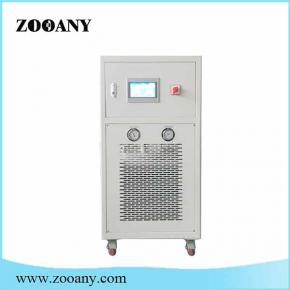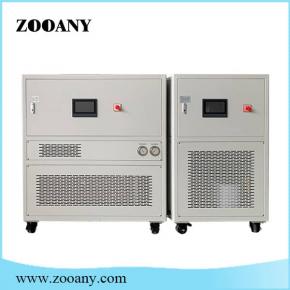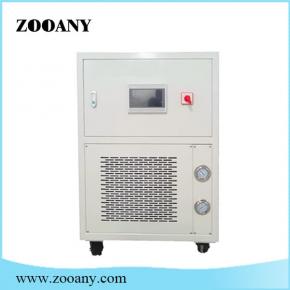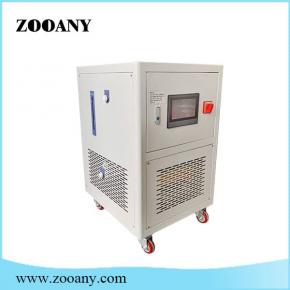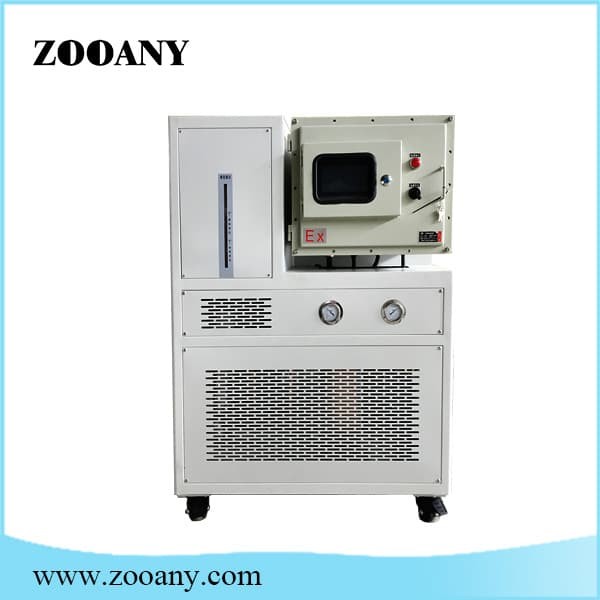
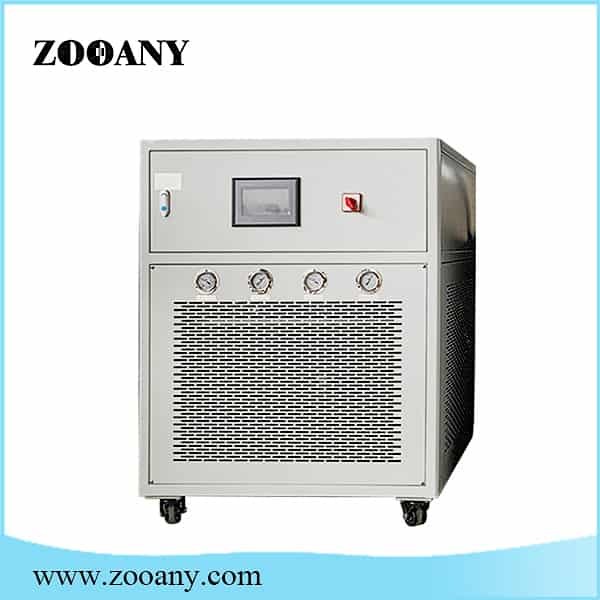
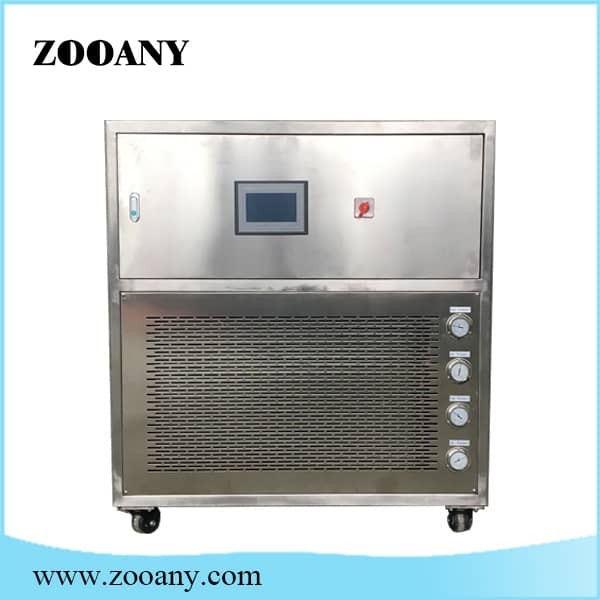
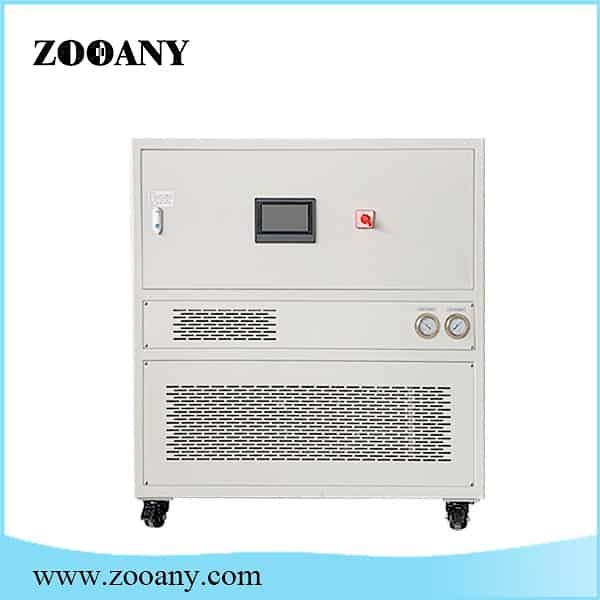
Temperature Range: -80℃ to 200℃
Operation Panel: PLC Control, 7-inch Color Touch Screen
Heating power: 1-25KW
Cooling power: 0.5-25KW
Customization supported
Meta Description: Discover how a -80°C to 200°C reactor temperature control unit provides precise heating and cooling for jacketed reactors. Explore its working principle, applications, key benefits, and why wide-range dynamic temperature control is essential for chemical and pharmaceutical processes.
-80°C to 200°C reactor temperature control unit (TCU) is a highly dynamic, closed-loop thermal management system designed to precisely regulate the temperature of jacketed reactors, pilot plant reactors, and laboratory-scale synthesis equipment across an extremely wide working range. Unlike conventional chillers or heaters that operate in narrow bands, this single-fluid unit seamlessly transitions from cryogenic cooling to high-temperature heating without switching heat transfer fluids, making it an all-in-one solution for demanding chemical, pharmaceutical, and materials science applications.
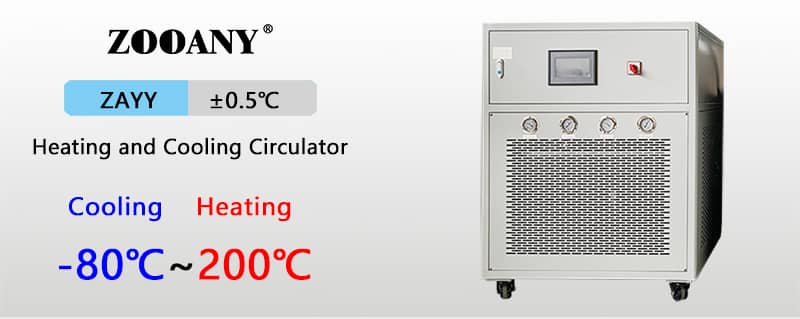
At the core of the -80°C to 200°C temperature control system is an integrated design that combines a powerful refrigeration cascade (typically using environmentally friendly refrigerants for low-temperature stages), efficient electric heating elements, and a sealed expansion tank. The system circulates a specially formulated thermal fluid — often a silicone-based oil — that stays stable and flowable from cryogenic conditions all the way up to 200°C. A variable-speed pump or sophisticated bypass valving allows the TCU to respond instantly to demand, delivering rapid heat-up and cool-down rates while protecting the reactor from thermal shock.
Key technical enablers include:
Cascade compressor refrigeration to reliably reach -80°C.
Sealed, air-free expansion system to prevent oil degradation and moisture absorption at low temperatures.
High-efficiency electric heaters with multi-stage control for smooth power delivery.
True single-fluid operation: no need to change between steam, water, or liquid nitrogen, reducing downtime and contamination risk.
This wide-range reactor cooling and heating circulator is indispensable in processes where reactions require extreme temperature profiles:
Pharmaceutical synthesis: cryogenic lithiation or Grignard reactions (-70°C) followed by reflux or distillation (up to 150–200°C) in the same process cycle.
Fine chemical and polymer production: exothermic reaction control with rapid heat removal, combined with high-temperature curing or crystallization steps.
Continuous flow chemistry: precise thermal management for steady-state operation across a broad temperature window.
Material testing and pilot plants: reproducing industrial temperature profiles at bench or kilo-lab scale, supporting scale-up studies and process development
Model | ZAYY-80-20 | ZAYY-80-30 | ZAYY-80-50 | ZAYY-80-100 | ZAYY-80-150 | |
Temperature Range | -80℃ to 200℃ | |||||
Control System | PID Adaptive Control Algorithm, PLC Programmable Controller | |||||
Temperature Control Mode | Material Temperature Control and Equipment Outlet Temperature Control Modes—Freely Selectable | |||||
Program Editing | PLC Control Allows Programming of 5 Programs, Each Program Can Be Composed of Up to 40 Steps | |||||
Communication Protocol | MODBUS RTU Protocol, RS485 Interface | |||||
External temperature feedback | PT100, 4–20mA, or communication-based setpoint (PT100 by default) | |||||
Temperature feedback | Three-point temperatures of the device’s heat transfer medium: inlet temperature, outlet temperature, and reactor material temperature (external temperature sensors) | |||||
Temperature control accuracy of the heat transfer fluid | ±0.5℃ | |||||
Material temperature control accuracy | ±1℃ | |||||
Heating power kW | 2.5 | 3.5 | 5.5 | 7.5 | 10 | |
Cooling capacity | 200℃ | 2.5 | 3.5 | 5.5 | 7.5 | 10 |
100℃ | 2.5 | 3.5 | 5.5 | 7.5 | 10 | |
0℃ | 2.5 | 3.5 | 5.5 | 7.5 | 10 | |
-40℃ | 1.8 | 2.6 | 3.3 | 5.8 | 6.4 | |
-60℃ | 1 | 1.4 | 1.6 | 3 | 3.5 | |
-75℃ | 0.3 | 0.42 | 0.7 | 1.3 | 1.5 | |
Circulating pump Maximum flow pressure | 20 L/min | 35 L/min | 35 L/min | 50 L/min | 60 L/min | |
Compressor | Compressors from brands such as Emerson Copeland, Tecumseh, and Doosan | |||||
Expansion valve | Danfoss/Emerson thermostatic expansion valve + Emerson electronic expansion valve | |||||
Evaporator | Plate Heat Exchanger | |||||
Operation Panel | PLC Control, 7-inch Color Touch Screen, Temperature Curve Display and Recording | |||||
Safety Protection | Features self-diagnosis capability; compressor overload protection; high-pressure pressure switch, overload relay, thermal protection device, and other multiple safety features. | |||||
Closed Loop | The entire system is fully sealed. At high temperatures, there will be no oil mist; at low temperatures, it will not absorb moisture from the air. During operation, the system will not experience pressure increases due to high temperatures, and at low temperatures, the heat transfer medium will be automatically replenished. | |||||
Refrigerant | R-404A/R23/R14 Mixed Refrigerant | |||||
Power Supply | 380V 50HZ / 460V 60HZ | |||||
Enclosure Material | Cold-rolled Steel with Powder Coating or SUS304 Enclosure | |||||
Optional | Explosion-proof Models ExdIIBT4/ ExdIICT4 | |||||
Unmatched Temperature Range
A single unit covering -80°C to 200°C eliminates the need for multiple heating and cooling devices, saving lab space, capital cost, and changeover time.
Exceptional Temperature Accuracy and Stability
Advanced PID or model-based control algorithms maintain reactor content temperature within ±0.1°C to ±0.5°C, even during exothermic peaks or endothermic demands, improving yield and selectivity.
Rapid Heat-Up and Cool-Down
High-capacity compressors and heaters, combined with a low thermal mass design, deliver cooling rates of several degrees per minute even near the low-temperature limit, and heating rates that quickly bring the system to 200°C.
Sealed, Low-Maintenance Fluid System
The closed circuit protects the thermal fluid from air and moisture, preventing oxidation, viscosity increase, and ice formation — critical for reliable operation at -80°C. Fluid lifespan is dramatically extended.
Safety and Process Protection
Built-in safety features include high/low temperature alarms, pressure and flow monitoring, automatic over-temperature protection, and fail-safe cooling (valves open on power loss). Cascade control with jacket and reactor sensors prevents dangerous temperature overshoots.
Multifunctional Process Support
Many units feature ramp-and-soak programming, recipe management, and communication protocols (Modbus, Profibus, Ethernet/IP) allowing seamless integration into automated plant control systems. Temperature profiles can be pre-programmed for multi-step syntheses.
Traditional approaches require a combination of a low-temperature chiller (-80°C or lower) and a separate heater or steam generator, with a switchover between fluids, complex valving, and significant dead time. A -80°C to 200°C single-fluid temperature control unit simplifies the thermal loop to one circulation system, one fluid, and one controller. This translates directly to:
Faster transition between hot and cold operation.
No contamination from fluid mixing.
Smaller footprint and simpler installation.
Lower overall total cost of ownership.
When specifying a reactor temperature control unit for -80°C to 200°C, consider:
Reactor volume and heat transfer area: Determines required heating and cooling capacity (kW).
Temperature change rate requirement: Influences compressor and heater sizing.
Thermal fluid compatibility: Silicone oils are standard; ensure the fluid’s viscosity at -80°C is acceptable.
Process control interface: Stand-alone PLC, remote control, or integration into a DCS.
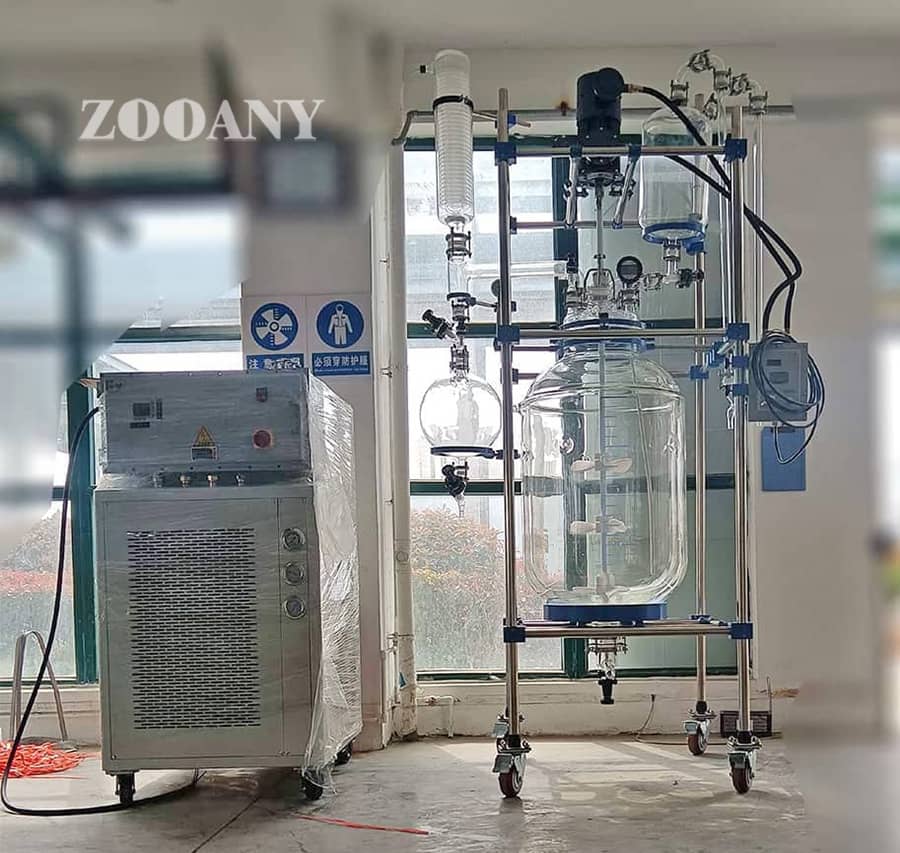
A -80°C to 200°C reactor temperature control unit represents the state of the art in laboratory and pilot-scale thermal management, combining extreme temperature range, high precision, and single-fluid convenience into one compact system. It empowers chemists and engineers to perform complex multi-step syntheses safely and efficiently, making it an essential asset in modern pharmaceutical development, fine chemicals, and advanced materials research.
For more information about our wide-range reactor TCUs, explore our product line or contact our thermal control specialists today.
Contact: Neil
Phone: +86-18205509969
E-mail: sales@zooany.com
Add: 118, Building 3, Tianrun City Phase II, Tianchang City, Anhui Province. China