Design Technical Guidelines for Constant Temperature and Humidity Clean Laboratory
The design project of constant temperature and humidity laboratory is widely used in cotton spinning, wool spinning, chemical fiber, papermaking, packaging, tobacco manufacturing enterprises, as well as quality inspection, fiber inspection and other departments. It complies with ISO and GB standards. Physical inspection of textiles, textile raw materials, paper, paper products and cartons must be carried out under standard atmospheric conditions.
1、 The core value of clean laboratory environment
The constant temperature and humidity clean laboratory is a special environmental space established through engineering methods, and its core functions are:
1.1 Precise control of environmental parameters
Temperature: Maintain an accuracy range of ± 0.002 ℃ to ± 2 ℃
Humidity: maintain a fluctuation range of ± 1.5% to ± 5%
Cleanliness: ISO Level 1 to ISO Level 9 gradient standards
1.2 Comprehensive prevention and control of pollutants
• Particle control: Filter suspended particles of 0.1-5 μ m
• Biological control: Inhibit the growth of microorganisms and bacteria
Chemical control: Remove harmful gases such as VOCs
• Physical control: eliminate static electricity and electromagnetic interference
2. Key points for the construction of professional constant temperature and humidity laboratories
2.1 Pre planning stage
2.1.1 Site evaluation elements
Building load-bearing capacity: must meet equipment load requirements (≥ 500kg/m ²)
Environmental interference: Keep away from vibration sources (distance>50m), electromagnetic fields (field strength<1V/m)
Infrastructure conditions: Floor height ≥ 3m, reserved equipment passage (≥ 1.2m)
2.1.2 Functional zoning design
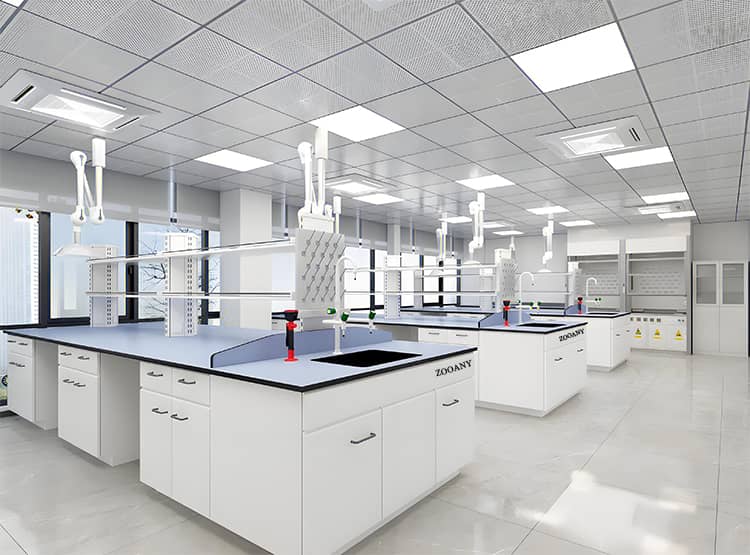
The layout of a constant temperature and humidity clean laboratory should follow the principles of functional zoning and separation of personnel and logistics. Usually divided into clean area, buffer area, and auxiliary area. The clean area is the core experimental area and requires strict control over the entry and exit of personnel and items; The buffer zone is used for changing clothes and cleaning, while the auxiliary zone includes equipment rooms, office areas, and sample storage areas.
The channel design of the laboratory should avoid cross contamination, and it is recommended to adopt a unidirectional flow design. Workbenches and equipment in the clean area should be arranged reasonably to avoid obstructing airflow. In addition, the laboratory should be equipped with emergency exits and fire-fighting facilities to ensure personnel safety. The layout design also needs to consider future expansion needs and reserve sufficient space and interfaces.
Core experimental area: Cleanliness standards ranging from Class 10000 to Class 100.
Buffer transition zone: Class 1000 cleanliness standard.
Auxiliary equipment area: independent air conditioning room design.
2.2. Technical system selection
2.2.1 Precision air conditioning system
Dual cooling source design: ensuring system redundancy.
Variable frequency control: energy saving of over 30%.
Third level filtration: Initial efficiency G4+Medium efficiency F8+High efficiency H13.
2.2.2 Intelligent control system
Adopting PLC+DC dual control architecture.
Accuracy classification
Conventional level: ± 1 ℃/± 5% RH.
High precision: ± 0.1 ℃/± 1.5% RH.
2.3. Engineering construction implementation
2.3.1 Standard for enclosure structure
Wall: 50mm rock wool color steel plate (fire-resistant grade A).
Ground: 2mm epoxy self leveling (anti-static ≤ 1 × 10 ^ 6 Ω).
Ceiling: Micro porous aluminum plate (opening rate 30%).
2.3.2 Key parameter control
Parameter type, control range, monitoring frequency.
Real time monitoring of temperature 20-25 ℃± 0.5 ℃.
Humidity 45-65% ± 2%, record every 5 minutes.
Pressure difference+10~+15Pa pressure difference sensing monitoring.
Noise ≤ 55dB (A) 8-hour equivalent measurement.
3. Acceptance and testing standards
Empty state detection: 24-hour operation test after completion.
Static detection: 48 hour test after equipment installation.
Dynamic detection: 72 hour verification of simulated working conditions.
Laboratory Design Summary:
The overall planning of the constant temperature and humidity clean laboratory aims to create a laboratory equipment workplace that ensures stable and reliable operation, extends service life, and meets user needs and employee physical and mental health.
Contact: Neil
Phone: +86-18205509969
E-mail: sales@zooany.com
Add: 118, Building 3, Tianrun City Phase II, Tianchang City, Anhui Province. China